

Why Pet Food Labels Are Worth Decoding
Pet food packaging is designed to sell a product, but buried beneath the lifestyle photography and bold claims is a set of legally regulated sections that give you real, usable information. Understanding those sections - and ignoring the parts that are mostly marketing - is one of the most practical things you can do for your pet's long-term health. Labeling rules for pet food in the United States are set by a combination of AAFCO model regulations and individual state agencies, so what appears on the label is not arbitrary.
This guide walks you through each meaningful section of a label in the order you are most likely to encounter it, from the product name on the front panel to the fine print on the back. For a broader look at how label literacy applies to product comparisons generally, see our guide to reading product comparisons without being misled.
Front-Panel Claims Are Largely Marketing
Terms like 'premium,' 'holistic,' 'natural,' and 'human-grade' have limited or no standardized regulatory definitions in pet food labeling. Relying on these claims alone - rather than the regulated sections of the label - can lead you to overestimate a food's nutritional quality. Always read past the front of the bag.
Step-by-Step: Working Through a Pet Food Label
Follow these steps the next time you pick up a bag or can. You do not need any special knowledge to start - just the label in front of you and a few minutes.
What you will need
Pet food package or label
The primary item you will be analyzing - any format works.
Magnifying glass or smartphone camera zoom
Fine print on labels can be very small; magnification helps avoid misreading.
AAFCO nutrient profile reference (available on AAFCO's official website)
Lets you cross-check the nutrient levels a food claims to meet.
Start with the product name - it carries legal weight
The name printed on a pet food package is not just branding. The AAFCO has naming rules that determine how prominently a protein can be featured. The '95% rule' means the named ingredient makes up at least 95% of the total product weight (excluding water). The '25% or dinner rule' applies when words like 'dinner,' 'entrée,' or 'platter' appear - that ingredient needs to be only 25% of the product. A food labeled 'with chicken' needs just 3% chicken. Knowing these thresholds stops you from assuming a protein-forward name equals a protein-rich formula.
Read the ingredient list with realistic expectations
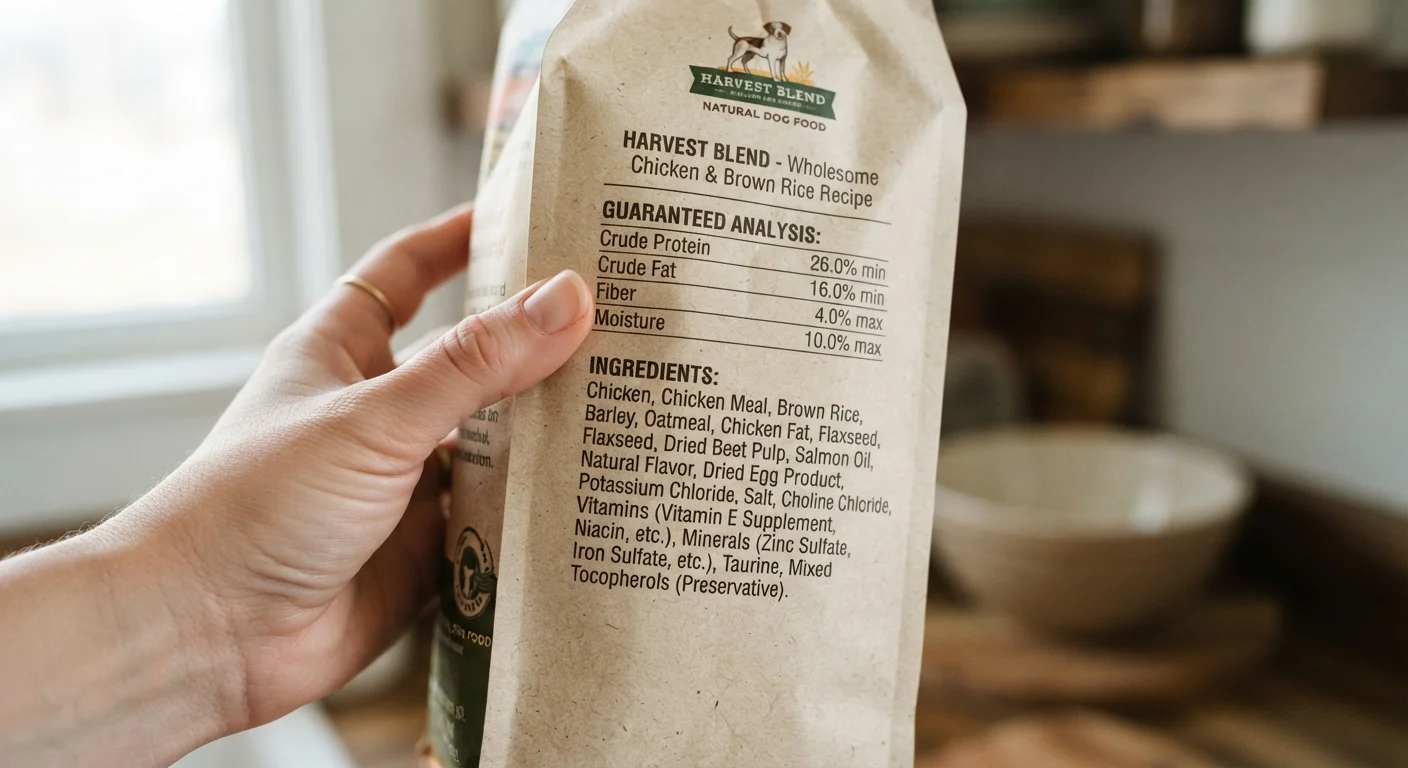
Ingredients are listed in descending order by pre-cooking weight, which means a fresh meat listed first may shrink considerably once moisture is cooked out. This is not necessarily a red flag - it is simply how ingredient listing works. Look for named protein sources (e.g., 'deboned chicken' rather than 'poultry by-product meal') and named fat sources. Be cautious of vague terms like 'animal digest' or 'meat and bone meal,' which offer less transparency about the protein source. A long ingredient list is not inherently bad, and a short one is not automatically superior - what matters is the quality and specificity of what is listed.
Decode the guaranteed analysis panel
The guaranteed analysis lists minimum percentages of crude protein and crude fat, and maximum percentages of crude fiber and moisture. These are not exact values - a minimum of 26% protein means at least 26%, not precisely 26%. Because wet foods contain far more moisture than dry kibble, direct comparisons between formats are misleading without converting to a dry matter basis. Divide each nutrient percentage by the dry matter percentage (100 minus moisture) to normalize the numbers. For pets with specific health conditions, your veterinarian may recommend foods that fall within tighter nutrient ranges than these minimums capture.
Find and interpret the AAFCO nutritional adequacy statement
This is arguably the most important regulated statement on the label. Look for a sentence such as: '[Product name] is formulated to meet the nutritional levels established by the AAFCO Dog Food Nutrient Profiles for all life stages.' This statement tells you two things: whether the food was formulated to meet a nutrient profile or whether it was validated through an AAFCO feeding trial (a more rigorous standard). It also tells you the intended life stage - adult maintenance, growth (puppies/kittens), all life stages, or supplemental/intermittent use only. A food labeled 'for supplemental or intermittent feeding' is not nutritionally complete and should not be used as a primary diet.
Check the manufacturer's contact information and lot code
U.S. regulations require a manufacturer name and address on every pet food label. A physical address or a named manufacturer - rather than just 'distributed by' language - can indicate more direct accountability for production. The lot number and 'best by' date are also essential: these are how recalls are tracked and how you verify freshness. If you ever need to report a product concern to the FDA, the lot code is the critical piece of identifying information.
AAFCO Statements Are Not Optional
A pet food that lacks an AAFCO nutritional adequacy statement has not been confirmed to meet established nutrient profiles for any life stage. Feeding such a product as a sole diet could leave your pet with nutritional gaps over time. Always look for this statement before making a food your pet's primary diet.
Use Dry Matter Basis to Compare Foods Fairly
Because wet and dry foods have dramatically different moisture levels, comparing guaranteed analysis numbers directly is misleading. Convert percentages to a dry matter basis by dividing each nutrient percentage by the percentage of dry matter (100 minus moisture percentage). This gives you a true apples-to-apples comparison across food formats. Your vet or a veterinary nutritionist can help if the math feels unfamiliar.
Putting It All Together for Your Pet
No label, however transparent, replaces individualized guidance from a veterinarian. Life stage, breed size, activity level, and health conditions all influence what 'good nutrition' actually means for a specific animal. The label tells you whether a food can support a healthy pet - your vet helps you determine whether it is the right fit for your pet. If your pet has been gaining or losing weight unexpectedly, our article on signs your pet's weight is quietly affecting their health covers what to watch for.
Label reading is also most useful when paired with accurate background knowledge. Many common assumptions about ingredients - from grains to by-products - are worth examining critically. Our look at persistent pet wellness myths and the evidence-based breakdown of grain-free vs. grain-inclusive diets can help you separate fact from marketing-driven folklore before you make your next decision.
This article is for general informational purposes only and does not constitute veterinary or nutritional advice. Consult a licensed veterinarian for guidance specific to your pet's health and dietary needs.