
Why Cat-to-Cat Introductions Require a Strategy
Unlike dogs, domestic cats are not instinctively pack animals. In the wild, most cats live and hunt alone, which means they have no hard-wired social script for greeting a stranger who suddenly shares their territory. When a resident cat discovers a new cat has appeared in its home, the default response is often fear, stress, or outright hostility - none of which sets a relationship up for success.
Understanding this biology is the foundation of a good introduction. The goal isn't to force friendliness; it's to manage the pace of exposure so that neither cat is overwhelmed. Behaviorally, cats need time to process new scents before they can evaluate a new companion with anything approaching calm. Skipping that phase and allowing immediate physical access is the most reliable way to create lasting conflict.
For a broader look at what drives feline behavior in general, the plain-language guide to common feline behaviors offers useful context. And if you're new to cat ownership altogether, what no one tells you before bringing a cat home covers the foundational setup every cat needs before you add a second one into the mix.
What You'll Need Before the New Cat Arrives
Preparation significantly reduces stress for both animals. Before the new cat crosses the threshold, make sure you have the right resources in place.
Separate "base camp" room
Gives the new cat a safe, contained space to decompress before meeting the resident cat.
Extra litter box
Ensures each cat has access to its own box; the standard rule is one box per cat plus one extra.
Separate food and water bowls
Prevents resource guarding and competition that can trigger or worsen conflict between cats.
Towel or soft cloth for scent swapping
Used to transfer each cat's scent to the other's environment during the early introduction phase.
Baby gate or screen door
Allows cats to see and smell each other safely before any unsupervised physical access is permitted.
Interactive wand toy
Used during feeding or play sessions near the door to build positive associations between the cats.
What you will need
Step-by-Step Introduction Process
Follow these steps in order. Skipping a phase or rushing between them is counterproductive - move to the next stage only when both cats appear calm and relaxed at the current one.
Set Up the New Cat's Base Camp
Before the new cat arrives, designate a single room as its exclusive space. Stock it with food, fresh water, a litter box, a scratching surface, hiding spots (a cardboard box works fine), and comfortable bedding. This room should remain off-limits to the resident cat. The new cat needs several days - sometimes longer - to feel safe in this space before any inter-cat contact begins.
Let Both Cats Adjust to Each Other's Scent
After two to three days, begin scent swapping. Rub a soft cloth on the new cat's face and cheeks, then place that cloth near the resident cat's food bowl - and vice versa. The goal is for each cat to associate the other's scent with something neutral or positive (like mealtime) before any visual contact occurs. Repeat daily, watching for relaxed or curious responses rather than hissing or avoidance.
Feed Both Cats Near the Closed Door
Once neither cat reacts strongly to the other's scent cloth, move their food bowls to either side of the closed base camp door - far enough apart that both cats eat comfortably. Over several days, gradually move the bowls closer to the door. The objective is a conditioned positive association: the smell of the other cat predicts something good (food). Do not proceed to the next step until both cats eat calmly near the door.
Allow Visual Contact Without Physical Access
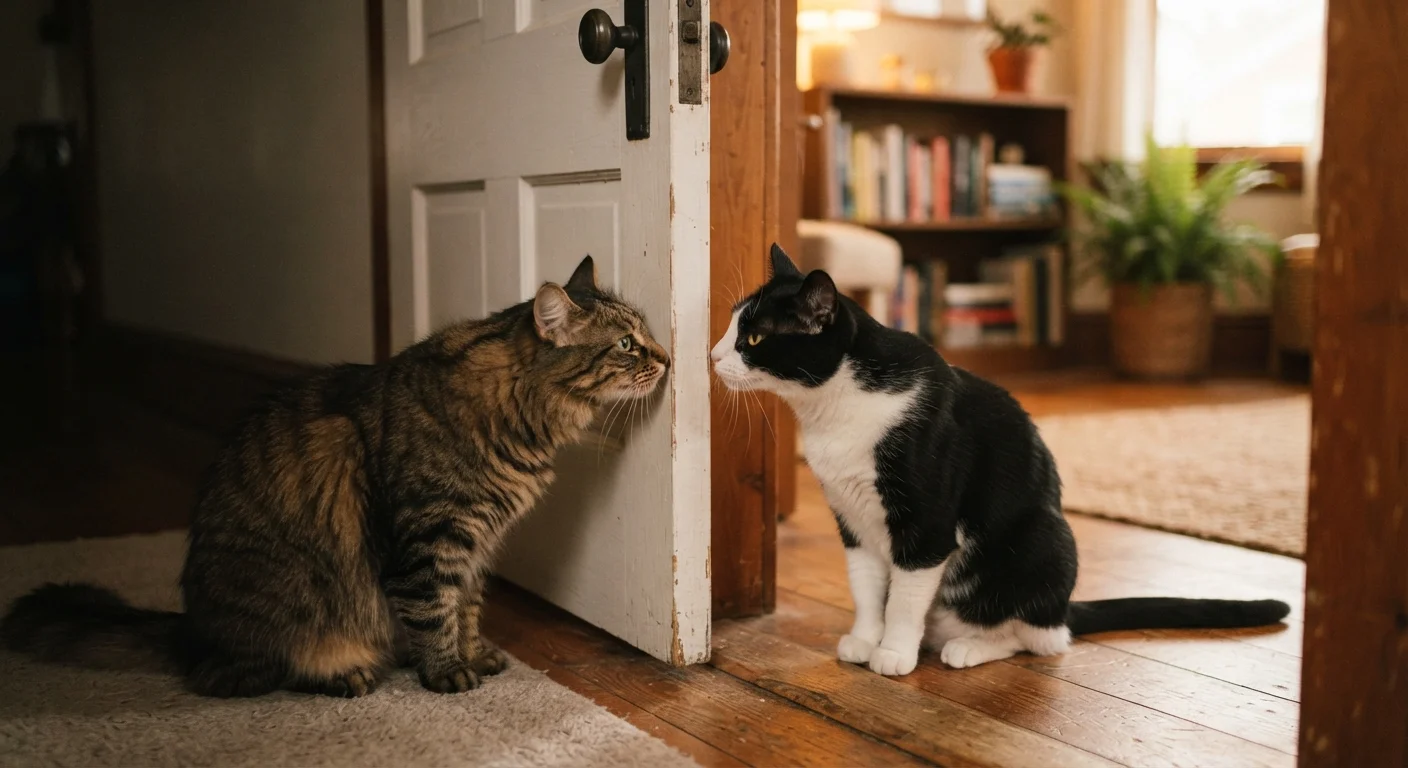
Crack the door slightly, use a baby gate, or install a temporary screen so both cats can see each other without the ability to make physical contact. Keep these sessions short - five to ten minutes - and engage each cat with a wand toy or treats during the visual exposure to maintain positive associations. Increase duration gradually over several days as both cats remain calm.
Supervised Face-to-Face Time
Open the door and allow both cats into a shared neutral space - ideally not the resident cat's core territory (its favorite sleeping spot or feeding area). Stay present and calm. Do not intervene in exploratory sniffing or even a brief hiss; these are normal. Do intervene if one cat corners the other or if chasing becomes sustained. Keep sessions short and end them on a calm note by separating the cats before tension builds.
Gradually Expand Shared Space
As supervised sessions go well, begin giving both cats access to larger areas of the home together. Continue providing separate resource stations - food, water, and litter - in different locations so neither cat has to compete or cross another's path to meet basic needs. Full integration, where you remove all physical separation, should only happen after both cats consistently ignore or interact calmly with each other.
Positive Associations Are the Core Mechanism
Every stage of this process works by pairing the other cat's presence with something each cat already values - food, play, or calm rest. If a step isn't progressing, the most reliable fix is slowing down and strengthening that positive association before moving forward. There is no shortcut that produces a better outcome than patience combined with consistent positive pairing.
Troubleshooting and When to Call Your Vet
Even a well-managed introduction can hit rough patches. Hissing and swatting during the first face-to-face meetings is normal and expected. What matters is the trajectory: stress signals should gradually decrease over days, not escalate. If either cat stops eating, hides for more than 48 hours continuously, or begins eliminating outside the litter box, slow the process back to the previous phase and give it more time.
Litter box avoidance is one of the most common stress responses during multi-cat transitions. The litter box problems many owners quietly struggle with article explains what's typically behind these issues and when a vet visit is warranted.
Ongoing aggression - defined as repeated chasing, cornering, or physical fighting that draws blood - is a signal to consult a veterinarian or a certified applied animal behaviorist. Pheromone diffusers (synthetic analogs of feline facial pheromones) are sometimes recommended as a supportive tool, but they are not a substitute for a proper introduction structure. For cats that remain highly stressed after weeks of careful effort, your vet can advise whether short-term behavioral support is appropriate. Enriching each cat's environment throughout the process also helps; what enrichment actually means for cats outlines practical ways to keep stress manageable in a shared home.
Don't Punish Hissing or Growling
Vocalizations like hissing are communication, not misbehavior. Punishing a cat for hissing suppresses the warning signal without reducing the underlying stress - and can actually make the situation less predictable and more dangerous. If hissing is frequent, interpret it as information: the process is moving too fast.