
Why the Summer-to-Fall Shift Trips People Up
The stretch from late August through October is genuinely one of the trickiest dressing periods of the year. Mornings can feel like fall while afternoons push back toward summer, and the pressure to "dress for the season" can lead to outfits that are either too warm, too cool, or just visually stuck in one season while the world outside has moved on.
The good news? You don't need a brand-new wardrobe to navigate it well. Most people already own the building blocks - they just need a framework for putting them together differently. For the big-picture principles behind dressing across all seasons, our year-round style primer is a great starting point.
Don't Pack Away Summer Too Fast
It's tempting to do one big seasonal swap the moment September hits, but temperatures can stay summer-warm well into October in many parts of the country. Hold back at least a week's worth of warm-weather outfits until nighttime lows consistently drop below 60°F. Premature packing means scrambling for breathable clothes on an 80-degree afternoon.
The steps below walk you through a practical, low-stress approach to transitional dressing - one that keeps you comfortable, put-together, and ready for whatever the week throws at you.
What You'll Need
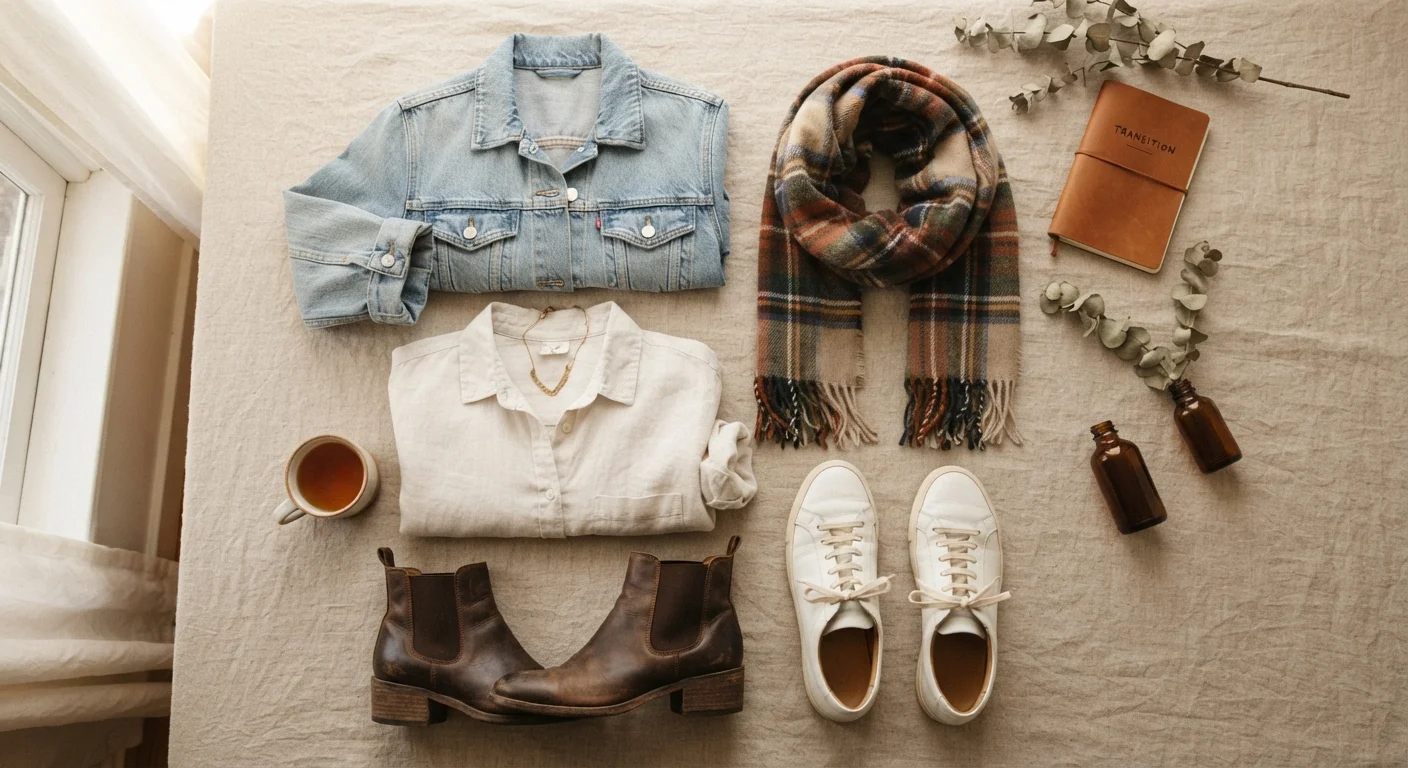
Good transitional dressing doesn't require a shopping haul. It starts with knowing what you already have and which pieces are genuinely doing double duty. Here are the tools that earn their place in a transitional wardrobe:
Denim or Chore Jacket
Acts as a go-to outer layer that pairs with both summer dresses and fall trousers without looking out of place.
Lightweight Scarf
Adds warmth and a fall-appropriate texture to summer outfits while remaining easy to remove when temperatures rise.
Ankle Boots
Bridge summer and fall footwear seamlessly - wear with bare legs, trousers, or midi skirts as the season shifts.
Neutral Midi Skirt
Pairs with summer tops now and heavier knits later, making it one of the hardest-working transitional pieces.
Lightweight Cardigan
Provides easy-to-remove warmth over sleeveless or short-sleeve summer tops during cooler mornings and evenings.
White or Cream Button-Down
Works tucked into shorts now and layered under a sweater or jacket once temps drop further.
Before diving into the steps, make sure you have these prerequisites sorted:
What you will need
The One-Bag Rule for Transitional Days
On days when the forecast swings 20 degrees or more, tuck a lightweight layer - a thin cardigan, a packable jacket, or a large scarf - into your bag before leaving the house. You won't need to second-guess your outfit, and you'll be comfortable whether it's 70°F at noon or 55°F by evening.
Step-by-Step: Transitioning Your Wardrobe
Audit Your Summer Wardrobe Before Putting Anything Away
Before you touch a storage bin, pull out everything you've been wearing this summer and group it into three piles: pieces that work only in heat, pieces that layer well, and pieces you barely touched. The middle pile is your transitional gold mine - those are the items that stay front and center in your closet for the next 6-8 weeks.
Identify Your Transitional Anchor Pieces
Transitional dressing works best when you build outfits around a small set of anchor pieces that feel seasonally neutral. Think straight-leg jeans, cotton midi skirts, chambray shirts, and simple fitted tees in warm or earthy tones. These items pair naturally with summer sandals now and ankle boots later without requiring a full outfit overhaul.
For a deeper look at which foundational pieces do the most work year-round, see our capsule wardrobe essentials guide.
Introduce Layers Without Retiring Summer Tops
The simplest transitional move is layering over pieces you're already wearing. A short-sleeve top or sleeveless dress you've been living in all summer immediately reads as fall-ready when you throw a denim jacket or lightweight cardigan over it. You're not replacing outfits - you're extending them.
Swap Your Footwear Strategically
Shoes signal the season more strongly than almost any other piece. Start phasing in ankle boots, loafers, or mules in place of flip-flops and strappy sandals - even if you're still wearing a summer dress on top. This single swap shifts the whole vibe of an outfit toward fall without requiring you to rethink your clothing. Keep one pair of comfortable sandals accessible for warm afternoons.
Shift Your Fabric Weight Gradually
As temperatures drop more consistently, start swapping out your lightest fabrics - thin cotton, linen, rayon - for mid-weight options like chambray, ponte knit, or cotton-modal blends. You don't need to go full flannel or wool yet. Think of it as a dial you turn slowly rather than a switch you flip. This keeps you comfortable through the unpredictable middle weeks of the season.
Plan Outfit Combinations Ahead of the Week
Transitional weeks are when last-minute dressing goes wrong most often. Spend 10 minutes on Sunday checking your local week's forecast and mentally mapping (or physically laying out) a few outfit combinations. Knowing Tuesday will be 78°F and Thursday will be 58°F means you won't reach for the wrong thing half-asleep at 7 a.m.
If your days shift from professional settings to casual errands, our guide on dressing for in-between days has practical outfit frameworks worth bookmarking.
Once you've worked through these steps, you'll have a wardrobe that responds to the season rather than fighting it. The goal isn't a perfect fall outfit - it's flexibility. And if you want to think about how these same principles apply to dressing across different occasions and dress codes, building a wardrobe that transitions from casual to formal is worth a read.
Avoid Heavy Fabrics Too Early
Reaching for wool sweaters and heavyweight knits in late August or early September can leave you overheated and uncomfortable by midday. Stick to mid-weight fabrics like cotton-linen blends, chambray, and light jersey until nighttime temperatures reliably cool down. Your body will thank you.