
The Physics Behind Why Distance Matters So Much
Speed transforms time into distance in ways that catch most drivers off guard. At 60 mph, a vehicle covers approximately 88 feet every second. The average human reaction time - from perceiving a hazard to pressing the brake - is roughly 1.5 seconds under alert, undistracted conditions. That means your car can travel more than 130 feet before the brakes even engage.
After braking begins, a typical passenger vehicle traveling at 60 mph requires an additional 120-140 feet to come to a complete stop on dry pavement. Add those figures together and you're looking at a total stopping distance that can exceed 270 feet - nearly the length of a football field.
A driver following two car lengths behind at highway speed has almost no margin for error. Any hesitation, distraction, or unexpected event - a child running into the road, a tire blowout ahead - compresses that window to nearly zero.
~29%
Share of all US crashes that are rear-end collisions
According to the National Highway Traffic Safety Administration (NHTSA), rear-end crashes are consistently one of the most common crash types on American roads.
1.5 sec
Average driver reaction time before braking begins
Traffic engineering standards commonly use 1.5 seconds as the baseline perception-reaction time for alert, unimpaired drivers.
270+ ft
Approximate stopping distance at 60 mph
Combining reaction distance and braking distance on dry pavement, a passenger car at 60 mph may need the length of a football field to stop completely.
The Psychology of Tailgating: Why Drivers Do It Anyway
Understanding tailgating purely as a physics failure misses half the story. Traffic psychology research consistently finds that emotional states - frustration, running late, perceived disrespect from slower drivers - are major contributors to following-too-closely behavior.
Drivers under stress tend to narrow their attention and underestimate risk. A phenomenon sometimes called optimism bias leads many motorists to rate their own reaction times as faster than average, even when objective testing suggests otherwise. This combination of emotional pressure and inflated self-assessment is a reliable recipe for dangerous following distances.
There is also the factor of habituation. Drivers who frequently travel congested corridors can become desensitized to close-following behavior because it feels normal in stop-and-go traffic. That tolerance often carries over - inappropriately - to higher-speed environments.
“Drivers consistently overestimate their ability to react quickly and underestimate how fast they are closing on a vehicle ahead. The gap they think is safe is often half what physics actually demands.”
— Transportation Safety Research Community, Consensus view reflected in traffic engineering literature and driver behavior studies
Conditions That Make the Problem Worse
Following distance requirements are not static. Several factors demand a larger buffer than the baseline 3-second rule.
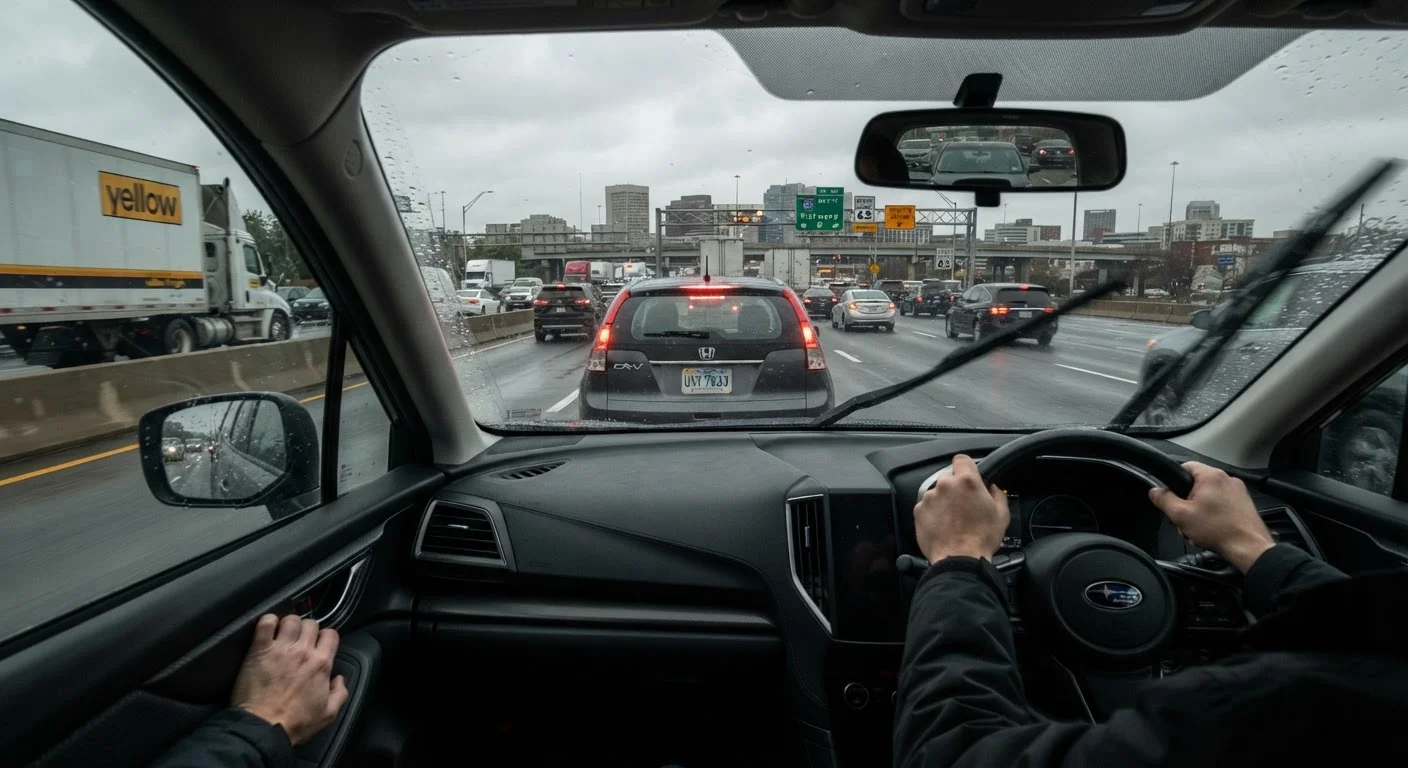
- Wet or icy roads: Braking distances can double or triple on slick surfaces. Adjusting your driving in bad weather starts with significantly increasing your following gap.
- Large or heavy vehicles: Trucks and SUVs take longer to stop and can obscure your view of hazards ahead. Give them additional space.
- Driver fatigue: Tired drivers exhibit reaction times comparable to legally impaired drivers. Fatigue stretches that critical pre-braking window considerably.
- Distraction: Even a momentary glance at a phone adds roughly 1-2 seconds of inattention - enough to erase any margin a reasonable following distance provided.
For drivers planning extended highway travel, our family road trip safety guide covers how fatigue and long-distance driving affect judgment and response time.
Use the 3-Second Rule Every Time
Find a fixed roadside marker - a sign, overpass, or shadow - and count the seconds between when the car ahead passes it and when you do. In rain, snow, or heavy fatigue, extend that count to at least five or six seconds. Making this a conscious habit on every trip is one of the simplest, highest-impact safety behaviors a driver can adopt.
Practical Steps to Keep Your Distance
The 3-second rule remains the most practical tool available to everyday drivers. When the vehicle ahead passes a fixed point - a sign, a bridge, a shadow - begin counting. If you reach that same point before reaching three seconds, you are following too closely. Back off gradually.
A few behavioral adjustments reinforce the habit:
- Leave earlier. Time pressure is one of the strongest predictors of aggressive following. Removing urgency removes much of the temptation.
- Scan further ahead. Looking two to four vehicles ahead - not just at the car directly in front - gives you earlier warning of slowdowns.
- Recognize the illusion of saved time. Closing a 2-second gap to 1 second at 65 mph saves less than a second per mile traveled. The risk is simply not proportional to the reward.
Technology like adaptive cruise control can assist with maintaining consistent gaps, but it does not replace attentive driving. Our piece on what driving aids actually cover explains where automated systems have real limits.
This article provides general road safety information for educational purposes only. Driving rules and regulations vary by state; always consult your state's DMV or official traffic code for requirements specific to your jurisdiction.