

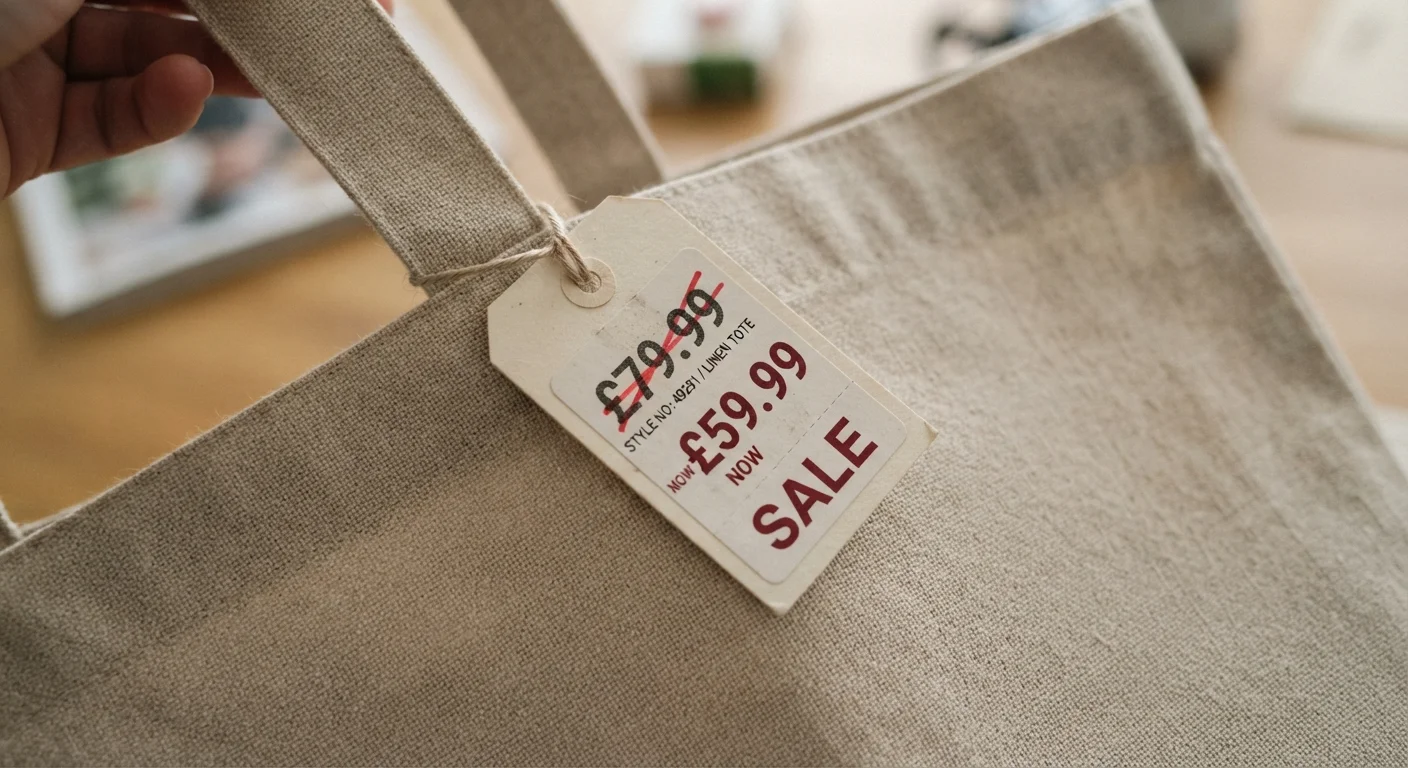
The Psychology Behind the Strikethrough
Walk through any retail store or scroll any shopping site and you'll encounter the same visual cue: a price with a line through it, sitting next to a lower number. That crossed-out figure - labeled "original price," "was," or "compare at" - is designed to create an immediate impression of value. The implicit message is: someone paid more for this; you're getting a deal.
But that impression depends entirely on one question: Was the reference price ever real? The answer, more often than shoppers realize, is complicated. Reference pricing is a legitimate retail practice, but it's also one of the most consistently misunderstood signals in consumer shopping. Understanding how these tags actually work is one of the most practical skills any shopper can develop - alongside reading unit prices and spotting fine print in product comparisons.
Common Myths - and What's Actually True
Several persistent beliefs shape how shoppers interpret price tags. Let's work through the most common ones.
Myth
The 'original price' on a tag is what the item actually sold for before the discount.
Fact
Reference prices often reflect a manufacturer's suggested price or a short-lived offering price - not a price at which meaningful sales occurred.
Retailers are generally free to set their own reference prices, and "original" can mean different things depending on the store. In some cases, a product may have been listed at a high price for only a brief window before being marked down - which means the lower price is, functionally, the standard price. The crossed-out number is more of a benchmark than a history of real transactions.
Myth
MSRP is a reliable anchor for understanding what a product is really worth.
Fact
MSRP is set by manufacturers, often at a level significantly above where the product routinely sells in the market.
Manufacturers' Suggested Retail Prices exist partly to give retailers room to discount and still appear competitive. In categories like electronics, appliances, and sporting goods, the gap between MSRP and actual street price can be substantial - sometimes 20-40% or more. Using MSRP as a fair-value reference can make ordinary market prices look like exceptional deals.
Myth
If a retailer shows a strikethrough price, there are laws guaranteeing it was a real price.
Fact
FTC guidelines require that reference prices reflect genuine prior offerings, but the standard is "offered," not "sold" - and enforcement is inconsistent.
A retailer can technically satisfy FTC guidance by listing a product at a high price for a period, even without actual sales at that level, then advertising a markdown. While regulators and state attorneys general have pursued egregious cases, most strikethrough pricing exists in a gray zone. Shoppers cannot assume regulatory compliance guarantees that the discount is meaningful.
Myth
A larger percentage discount always signals a better deal.
Fact
The size of a stated discount only matters if the starting reference price is accurate - a 50% discount off an inflated price may save you nothing compared to a competitor's regular price.
Percentage savings figures are mathematically dependent on the reference price used. If a $100 item is marked down to $60, that's a 40% discount - but if the market price at other retailers is $55, the "deal" is actually more expensive. Reading comparisons carefully and checking prices across sources matters far more than the stated percentage.
Myth
Online 'compare at' tags work the same as in-store 'original price' tags.
Fact
'Compare at' often references a competitor's price or MSRP, not the retailer's own former price - making it a different type of claim altogether.
The distinction matters because the implied promise is different. An "original price" suggests the seller charged that amount before. A "compare at" price suggests another retailer (or the manufacturer) prices it higher - which may or may not be true in the current market. Neither claim is automatically reliable, but they represent different types of assertions that should be evaluated separately.
What Reference Pricing Rules Actually Say
The Federal Trade Commission (FTC) has guidance stating that a former price used as a reference should reflect an actual price at which the product was offered for a reasonable period of time. The key phrase is "offered" - not necessarily sold. A retailer can post an item at a high price for a period, then mark it down, technically satisfying the requirement even if very few or no units moved at that price.
The 'Offered' vs. 'Sold' Distinction Matters
Under FTC guidance, a reference price must reflect a price at which the product was genuinely offered - but "offered" does not necessarily mean a significant number of customers paid that price. A short listing window at a high price can satisfy the technical standard. This means reference price compliance does not guarantee the discount reflects real-world savings.
State laws add another layer of complexity. Some states have stricter rules requiring that reference prices reflect actual sales volume, while others rely primarily on the FTC's framework. The result is an uneven landscape where the same pricing tactic may be more or less regulated depending on where you're shopping. For a deeper look at how sale labels get applied, see what retail, sale, and clearance pricing actually signal.
How to Evaluate a Price Tag More Reliably
The most useful habit is simple: treat the reference price as a data point worth verifying, not a fact worth trusting. Here's what that looks like in practice:
- Search the product's price history. Free tools exist that track online pricing over time, showing whether a "sale" price is genuinely lower than usual or simply the product's standard price with a different label.
- Check multiple sellers. If a reference price reflects a manufacturer's suggested retail price (MSRP), compare what other retailers actually charge. A wide gap between MSRP and street price often signals the MSRP was never realistic.
- Look at the "compare at" language carefully. When a tag says "compare at" rather than "originally," it may be comparing to a different retailer's price - not the store's own former price.
- Consider the product's context. Is this an item that goes on sale repeatedly? Seasonal and clearance goods often carry inflated reference prices to make routine markdowns appear more dramatic.
Watch for Perpetual 'Sales' on the Same Item
If a product appears to be on sale every time you check, the lower price is likely its actual standard price. Retailers in some categories - particularly furniture, bedding, and home goods - have historically used nearly continuous sale events. When a sale never ends, the "original" price loses practical meaning as a reference point.
Reference pricing isn't always deceptive - sometimes a strikethrough genuinely reflects a meaningful price drop. The goal isn't cynicism; it's calibration. Learn more about judging whether a discount is real before making a decision based on the tag alone.