

Why Debt Myths Are So Persistent
Debt is one of the most emotionally charged topics in personal finance. That pressure makes people vulnerable to advice that sounds logical but doesn't hold up under scrutiny. Well-meaning friends, outdated rules of thumb, and oversimplified headlines all contribute to a set of deeply held beliefs that can quietly work against your progress.
Understanding the difference between debt fact and fiction is a practical step - not just an academic one. The wrong approach can cost hundreds or thousands of dollars in unnecessary interest, or even damage your credit when you're trying to repair it. Before exploring the myths, it helps to be clear on what kinds of debt you're dealing with. Revolving and installment debt behave very differently, and that distinction shapes every strategy below.
Myth
Making the minimum payment on time means I'm managing my debt responsibly.
Fact
Minimum payments keep your account in good standing, but they allow interest to compound aggressively - extending your payoff timeline by years and significantly increasing total cost.
Credit card minimum payments are typically set at 1-3% of your outstanding balance or a flat dollar amount - whichever is greater. While paying the minimum avoids late fees and protects your payment history, the remaining balance continues to accrue interest daily on most cards. On a $5,000 balance at 20% APR, paying only the minimum each month could take over a decade to resolve and cost more than the original balance in interest alone. Paying even a modest amount above the minimum each month meaningfully shortens this timeline.
Myth
Debt consolidation solves my debt problem.
Fact
Consolidation restructures how you repay debt - it does not reduce the amount owed. Without a changed spending pattern and a clear repayment plan, the same debt can return.
Debt consolidation - rolling multiple balances into a single loan or balance-transfer card - can simplify payments and potentially reduce your interest rate. But it's a tool, not a solution. If the habits that created the debt don't change, many people find themselves back in the same situation, sometimes with additional balances on top of the consolidated loan. Consolidation works best when paired with a concrete payoff plan and, ideally, a realistic budget. Understanding your credit situation is also essential before choosing a consolidation product, since your credit score affects the terms you'll qualify for.
Myth
Closing a credit card once it's paid off is the responsible move.
Fact
Closing a paid-off card can lower your credit utilization ratio and shorten your credit history - both of which may reduce your credit score.
Credit utilization - the percentage of your available credit you're using - accounts for a significant portion of your credit score. When you close an account, you eliminate that card's available credit limit, which raises your utilization ratio if you carry balances elsewhere. Additionally, older accounts contribute positively to the length of your credit history. Unless a card carries an annual fee that isn't worth paying, keeping a paid-off account open and occasionally using it for a small purchase (then paying it in full) is often the sounder approach. For more on how these factors interact, see Credit Score Myths That Cost People Money.
Myth
All debt is bad and should be eliminated as fast as possible.
Fact
Not all debt carries the same cost or risk. High-interest consumer debt warrants urgency; lower-rate debt may be less financially damaging than liquidating savings to eliminate it.
The priority you assign to paying off debt should generally track its interest rate. High-interest credit card debt at 20%+ APR erodes financial stability quickly and typically warrants aggressive repayment. A fixed-rate student loan or mortgage at a lower rate may be less urgent - especially if you have no emergency fund. Wiping out savings to pay off low-interest debt can leave you without a cushion for unexpected expenses, which may force you to take on new high-interest debt. Context and interest rate matter far more than a blanket rule about eliminating all debt immediately.
Myth
Seeking help for debt means going through bankruptcy.
Fact
Nonprofit credit counseling agencies offer structured debt management plans and financial education that are entirely separate from bankruptcy proceedings.
Bankruptcy is a legal process with significant long-term credit consequences and is one of several options - not a default outcome for people struggling with debt. Nonprofit credit counseling agencies, many of which are accredited through organizations like the National Foundation for Credit Counseling (NFCC), offer debt management plans (DMPs) that negotiate reduced interest rates with creditors and create a structured repayment schedule. These services are typically low-cost or free. Speaking with a licensed financial counselor early - before accounts go delinquent - preserves more options and is a sign of proactive financial management, not failure.
[warning_callout]Building a Clearer Path Forward
Busting these myths isn't just about correcting bad information - it's about unlocking better decisions. Once you know the actual mechanics of interest accrual, credit scoring, and debt consolidation, your options become clearer.
20%+
Average credit card APR in recent years
The Federal Reserve has tracked average credit card interest rates above 20% APR, making high-rate card debt one of the most expensive forms of consumer borrowing.
1-3%
Typical minimum payment as share of balance
Most credit card issuers set minimums at roughly 1-3% of the outstanding balance, which is designed to keep accounts current - not to efficiently reduce debt.
30%
Credit utilization's weight in common scoring models
Credit utilization - how much of your available credit you use - accounts for approximately 30% of a FICO score, making account closures a meaningful credit risk.
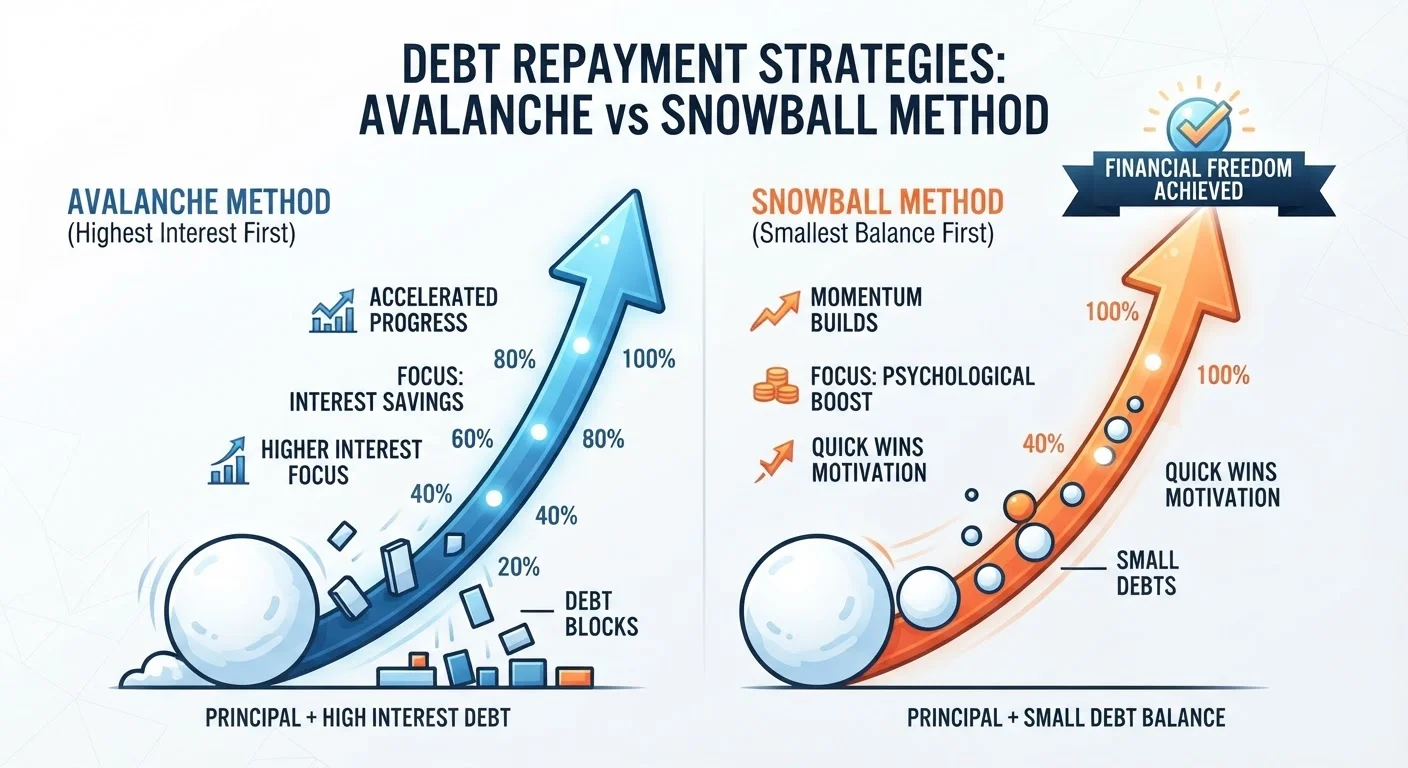
Two well-established repayment frameworks - the debt avalanche (highest interest rate first) and debt snowball (smallest balance first) - give structure to a payoff plan. Each suits different situations, and neither requires a perfect budget to work. Compare both methods side by side to see which fits your circumstances.
If the terminology in your statements feels confusing, that's worth addressing early. Terms like APR, principal, and grace period all affect how much you pay and when. A solid grounding in key borrower terms removes a lot of the guesswork.
Debt payoff also doesn't exist in a vacuum. A realistic monthly budget is what turns a repayment strategy into a repayment reality. If budgeting itself feels like a barrier, budgeting basics and the article Budgeting Beliefs That Keep People Broke address the mindset obstacles that often come first.
This article is for general informational purposes only and does not constitute personalized financial, legal, or tax advice. Debt situations vary widely - consider speaking with a licensed financial counselor or advisor about your specific circumstances.