
How Each Method Works
Both strategies share a common structure: you make minimum payments on every debt you carry, then direct any additional dollars toward one targeted account. The difference is which account gets that extra attention first.
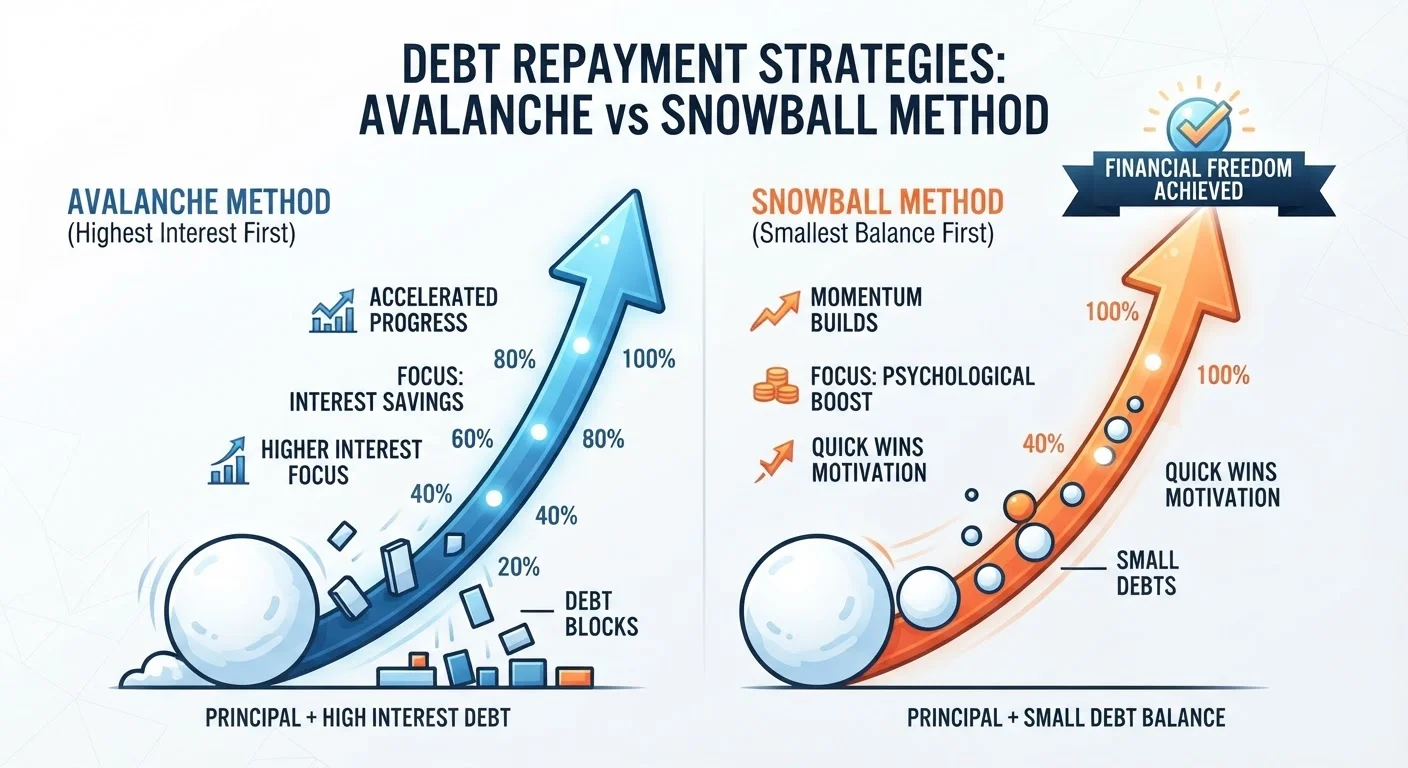
Debt Avalanche: You rank your debts from highest annual percentage rate (APR) to lowest. Every extra dollar goes toward the highest-rate balance until it's gone, then you roll that entire payment amount onto the next highest-rate debt, and so on. Because high-interest debt accumulates charges fastest, eliminating it first reduces the total interest you'll pay across the life of your repayment plan.
Debt Snowball: You rank debts from smallest balance to largest, regardless of interest rate. Extra payments attack the smallest balance first. Once that account is paid off, its former payment amount is added to the next-smallest balance - creating a growing "snowball" of payment power. The appeal is psychological: you close out individual accounts relatively quickly, which many people find encouraging.
Before diving deeper, it helps to understand terms like APR and minimum payment. Our guide to key borrower terms explains these concepts in plain language.
| Debt Avalanche | Debt Snowball | |
|---|---|---|
| Primary ranking factor | Highest interest rate first | Smallest balance first |
| Total interest paid | Generally lower | Potentially higher |
| Time to first payoff | Longer if highest-rate debt is large | Faster - smallest balance cleared first |
| Motivational structure | Rewards patience and long-term focus | Delivers quick wins and momentum |
| Complexity | Requires tracking APRs across accounts | Simple - sort by balance |
| Best scenario | High-rate debts dominate your balance | Many small accounts spread across creditors |
The Real Cost Difference
In most scenarios, the avalanche method results in less total interest paid. This is because interest compounds - meaning a 24% APR credit card balance grows substantially faster than a 9% personal loan balance of the same size. Paying off the high-rate debt first cuts off that compounding at its most expensive source.
The snowball method, by contrast, may leave high-rate balances open longer. The trade-off is that you eliminate individual accounts sooner, reducing the number of creditors you're managing simultaneously. For some people, that simplification has real value.
~$1,000+
Potential interest savings with avalanche
Consumer finance analyses commonly show avalanche users saving hundreds to over a thousand dollars compared to snowball, depending on balances and rates.
1 in 3
Americans carrying credit card debt monthly
Federal Reserve surveys consistently find roughly one-third of U.S. adults carry an unpaid credit card balance from month to month.
The gap between the two methods in total interest paid will vary depending on your specific balances, rates, and the amount of extra payment you can apply. If your highest-rate debt also happens to be your smallest balance, the two methods may produce nearly identical results.
Choosing Based on Your Situation
Financial educators and counselors often note that the "best" debt payoff method is the one a person actually completes. If a mathematically superior plan leads to burnout or abandonment after a few months, it isn't serving its purpose.
Hybrid Approach: Start Small, Then Pivot
Some people begin with the snowball method to build confidence by eliminating one or two small balances quickly, then switch to the avalanche once they feel momentum. This hybrid isn't a formal strategy, but it can be effective if early discouragement is your biggest obstacle. Just make sure you maintain minimum payments on all accounts throughout the process.
Consider the avalanche if: your high-interest balances are not dramatically larger than your other debts, you're comfortable with delayed visible progress, or reducing total cost is your primary goal.
Consider the snowball if: you've tried paying off debt before and lost momentum, you have multiple small balances that feel overwhelming, or you respond strongly to measurable milestones like a zeroed-out account.
It's also worth noting that debt repayment doesn't happen in isolation. Freeing up cash flow requires attention to your broader spending habits. Our framework for spending less without downgrading can help you find room in your budget without sacrificing quality of life. And if you're still building foundational financial habits, our starter framework for savings and credit offers a grounded starting point alongside debt repayment.
This article is for general informational purposes only and does not constitute personalized financial, tax, or legal advice. Consult a qualified financial professional for guidance specific to your situation.