
How Exchange Rates Actually Work - and Why the Gap Matters
The exchange rate you see on a financial news site or currency converter is called the mid-market rate - the midpoint between buying and selling prices on the global currency market. It's the rate banks use when trading with each other. It is not the rate most travelers actually receive.
Every business that converts currency - airport kiosks, hotel desks, ATMs, even your own bank - applies a markup above the mid-market rate. That markup, along with any flat service fees, is how they profit on the transaction. Understanding this gap is the foundation of smarter currency management abroad.
For a trip of any real length, these markups accumulate fast. A 5% markup on $2,000 worth of spending is $100 gone before you've bought a single souvenir. A 10% markup - not uncommon at airport kiosks - doubles that loss. The good news: the gap is largely avoidable once you know what drives it. See our international trip planning checklist for more on preparing your finances before departure.
1-3%
Typical foreign transaction fee per card purchase
Many standard U.S. credit and debit cards apply a foreign transaction fee of 1-3% on purchases made in a foreign currency, according to general industry disclosures.
Up to 10%
Markup at airport currency exchange kiosks
Consumer finance research has documented airport exchange markups well above mid-market rates, sometimes reaching double digits when fees are included.
3-8%
Typical dynamic currency conversion markup
Studies of point-of-sale DCC transactions suggest merchants frequently apply markups of 3-8% above the mid-market rate, though the precise figure varies by provider.
The Six Currency Mistakes Draining American Travelers' Budgets
Most currency overpayment doesn't happen because travelers are careless - it happens because the system is designed to look convenient while quietly charging more. These are the six most common and costly errors, and exactly how to sidestep them.
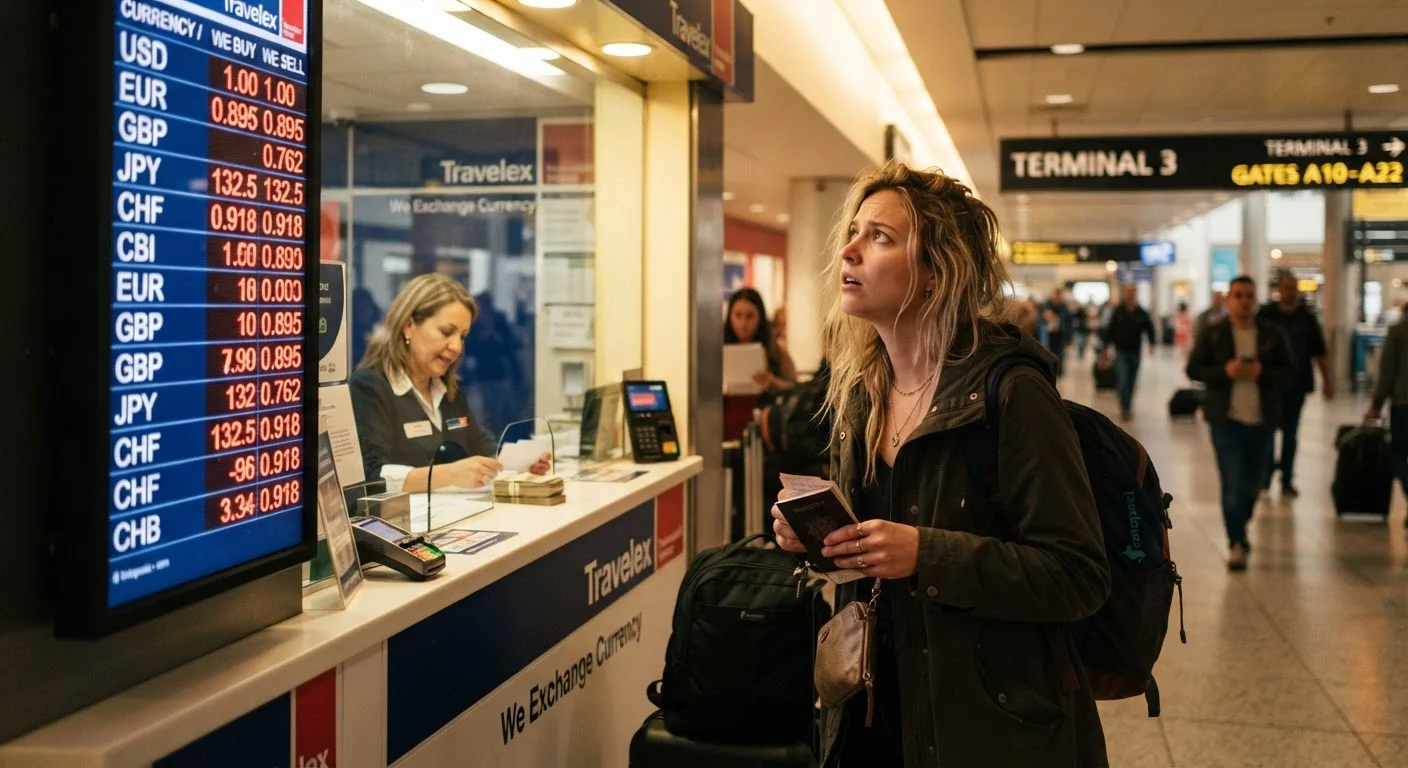
Exchanging currency at the airport kiosk upon arrival.
Why it happens: Travelers assume the airport is the easiest and most official place to get foreign cash, so they head straight to the exchange counter after landing.
Accepting dynamic currency conversion (DCC) at point of sale or ATMs.
Why it happens: The prompt looks helpful - paying in dollars feels familiar and removes guesswork about the final amount.
Using a credit or debit card that charges foreign transaction fees on every purchase.
Why it happens: Many travelers don't read their card's fee schedule before departing and only notice the charges when reviewing their statement back home.
Relying on hotel front desks or tourist-area exchange shops for currency.
Why it happens: These options feel safe and accessible, especially when travelers are unfamiliar with the local banking infrastructure.
Not understanding the mid-market rate before comparing exchange offers.
Why it happens: Most travelers have never looked up the mid-market rate and have no benchmark to judge whether a quoted rate is fair or inflated.
Carrying only cash or only cards without a backup plan.
Why it happens: Travelers often assume one payment method will work everywhere, or pack so much cash they end up converting back at a loss upon return.
Dynamic Currency Conversion Is Almost Never in Your Favor
When a foreign merchant or ATM offers to charge you in U.S. dollars instead of local currency, that's dynamic currency conversion (DCC). It sounds convenient, but the exchange rate applied is set by the merchant or their payment processor - not your bank - and it's typically far less favorable. Always choose to pay in the local currency and let your card issuer handle the conversion.
Currency decisions are a form of financial planning, and the same careful thinking that applies at home carries over to travel. If your overall spending discipline tends to slip mid-trip, the strategies in our budgeting guide translate surprisingly well to travel contexts too.
Building a Simple Currency Strategy Before You Fly
The travelers who consistently pay the least for currency exchange share one trait: they make decisions at home, not in a foreign airport under time pressure. A quick pre-trip currency checklist takes about 30 minutes and can save meaningfully over a two-week trip.
- Check your cards: Identify which cards in your wallet charge foreign transaction fees and which don't. Keep the fee-free card accessible; leave the others at home if possible.
- Look up the mid-market rate: Note the rate for your destination's currency so you have a benchmark when evaluating exchange options on the ground.
- Order a starter amount of foreign cash: Many U.S. banks allow customers to order foreign currency for branch pickup. A modest amount - enough for transit and the first day - means you don't need to panic-exchange at the airport.
- Notify your bank: Letting your bank know you're traveling reduces the chance of your card being flagged for fraud abroad.
- Identify ATM networks at your destination: Some U.S. banks have partnerships with foreign banks that reduce or eliminate ATM fees. A quick search before you leave pays off.
Currency is just one piece of the international travel preparation puzzle. For a broader view of what to verify before any international departure - including visas, travel insurance, and health documentation - explore our complete pre-travel checklist. And if you're new to thinking about travel insurance, it's worth understanding how financial protection abroad works alongside smart currency management.
This article is for general informational purposes only and does not constitute financial or investment advice. Exchange rates, card fees, and bank policies vary by provider and change over time. Verify current terms directly with your card issuer or financial institution before traveling.